Austin Seven Club of South Africa
|
| Austin evolution to Jaguar > Austin Seven Club of South Africa |
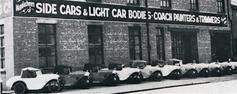
As soon as William Lyons came of age, he and Walmsley formed the Swallow Sidecar Company on 4th September 1922 with a bank overdraft of £1,000. Securing first and second floor premises in Bloomfield Road, Blackpool, they commenced commercial production of the sidecars together with a small team of eight employees, including a young Arthur Whitaker. Although initially employed to help with sales, Whitaker’s strength lay in purchasing and he was to remain with Lyons for some 50 years, proving himself to be one of the most shrewd purchasers in the business. Lack of factory space soon became a problem, and two further Blackpool sites were taken over – in Woodfield Road (mainly for dispatch purposes) and, shortly afterwards, in John Street which was fortuitously situated close to the main Swallow premises. In mid-1926, plans for producing motor-car bodies were well under way, and this – together with the year-by-year increase in production of the sidecars – made it necessary for Swallow to move into a larger building. The entire removal to the Cocker Street works took just two days with no assistance from outside sources, other than one pantechnicon and driver.
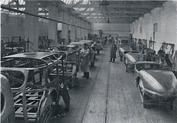
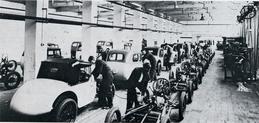
In 1928 the business was moved from Blackpool, where there was a serious shortage of skilled labor, to an old ammunition factory at Foleshill, Coventry. Capable of only producing 2 cars per day in the existing factory, an order from Henlys for 500 Austin Swallows effectively forced this move. With a fivefold increase in floor space, Swallow production could be upped from twelve to fifty cars per week. The move also reduced costs as it was no longer necessary to transport the chassis from their manufacturers in the Midlands up to Blackpool.
In 1931 the larger Standard 16 hp six-cylinder Enfield chassis received the Swallow treatment, introducing the company to the 2054cc side valve engine, which they were to utilize for their next ambitious step forward. Meanwhile a model of rather more sporting pretensions was introduced with the Swallow version of the Wolseley Hornet, and in 1932 the even more sporty Hornet Special.
|
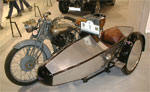 The
origins of Jaguar can be traced back to the northern seaside town of
Blackpool in the early 1920s. It was here that a young motorcycle
enthusiast, Bill Lyons (b. 1901), not yet 21 years of age, met William
Walmsley (b. 1891) who was building attractive motorcycle sidecars and
attaching them to reconditioned motorbikes. Walmsley had not long arrived in
Blackpool with his parents from Stockport, and both families happened lived
in the same street – King Edward Avenue.
The
origins of Jaguar can be traced back to the northern seaside town of
Blackpool in the early 1920s. It was here that a young motorcycle
enthusiast, Bill Lyons (b. 1901), not yet 21 years of age, met William
Walmsley (b. 1891) who was building attractive motorcycle sidecars and
attaching them to reconditioned motorbikes. Walmsley had not long arrived in
Blackpool with his parents from Stockport, and both families happened lived
in the same street – King Edward Avenue.  It
was in late 1926, and announced to the public in May 1927, that the Swallow
Sidecar and Coachbuilding Company first diversified by taking an existing
car and bodying it with more fashionable coachwork. The first model to
benefit was the popular, but basic, Austin Seven. Intended to bring motoring
to the masses, the Austin's were cheap and easy to run, but Lyons believed
“… that it would also appeal to a lot of people if it had a more luxurious
and attractive body.” Lyons persuaded Stanley Parker, a dealer in Bolton,
Lancashire, to supply him with a new Austin Seven chassis and the result,
largely thanks to the efforts of Cyril Holland, a coachbuilder who had been
hired from the Midlands, was the Austin Seven Swallow – a distinctive open
tourer, with its own cowled radiator, and at £175 (£185 with the hinged hard
top) remained well within the budget of many Austin owners. Three months
later, a Morris Cowley Swallow two-seater was introduced, fitted – like the
Austin – with Aluminium panels over a wooden frame.
It
was in late 1926, and announced to the public in May 1927, that the Swallow
Sidecar and Coachbuilding Company first diversified by taking an existing
car and bodying it with more fashionable coachwork. The first model to
benefit was the popular, but basic, Austin Seven. Intended to bring motoring
to the masses, the Austin's were cheap and easy to run, but Lyons believed
“… that it would also appeal to a lot of people if it had a more luxurious
and attractive body.” Lyons persuaded Stanley Parker, a dealer in Bolton,
Lancashire, to supply him with a new Austin Seven chassis and the result,
largely thanks to the efforts of Cyril Holland, a coachbuilder who had been
hired from the Midlands, was the Austin Seven Swallow – a distinctive open
tourer, with its own cowled radiator, and at £175 (£185 with the hinged hard
top) remained well within the budget of many Austin owners. Three months
later, a Morris Cowley Swallow two-seater was introduced, fitted – like the
Austin – with Aluminium panels over a wooden frame.  The
Austin Swallow proved popular and was followed in 1928 by the Austin Seven
Swallow Saloon – a car that looked much more expensive than it actually was.
By aping the style of the more luxurious cars of the era, the Swallows
allowed their owners to “keep up appearances” at a time of economic hardship
for many.
The
Austin Swallow proved popular and was followed in 1928 by the Austin Seven
Swallow Saloon – a car that looked much more expensive than it actually was.
By aping the style of the more luxurious cars of the era, the Swallows
allowed their owners to “keep up appearances” at a time of economic hardship
for many. 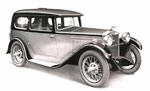 At
the annual London Motor Show in 1929, three new Swallow models appeared for
the first time. These were based on the existing Standard Big Nine, Swift
Ten, and Fiat Tipo 509A chassis. The Standard Swallow was a rather larger
saloon than the previous models, selling for £245, but still offered a more
extravagant body style than the manufacturer’s own car.
At
the annual London Motor Show in 1929, three new Swallow models appeared for
the first time. These were based on the existing Standard Big Nine, Swift
Ten, and Fiat Tipo 509A chassis. The Standard Swallow was a rather larger
saloon than the previous models, selling for £245, but still offered a more
extravagant body style than the manufacturer’s own car.